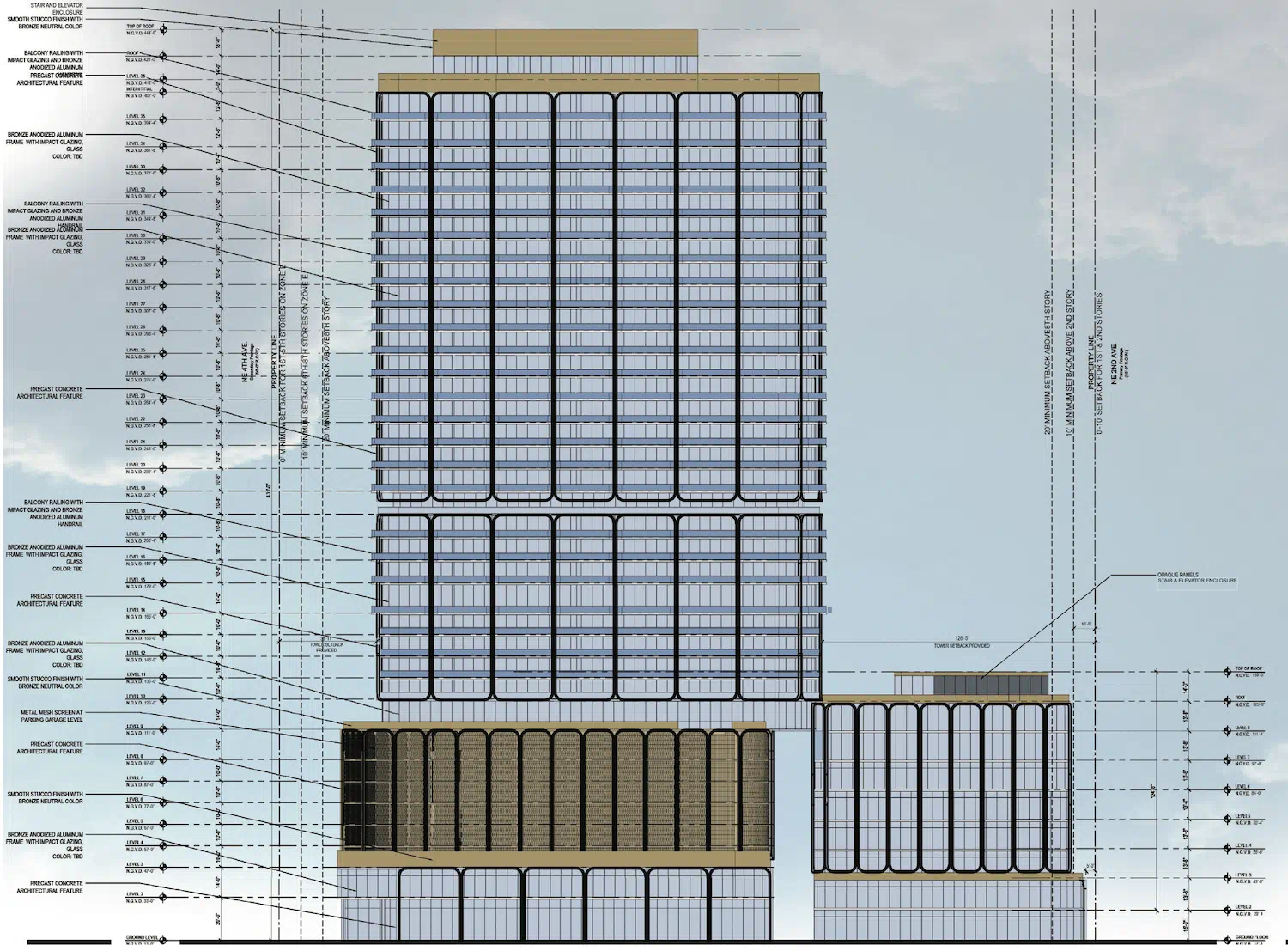
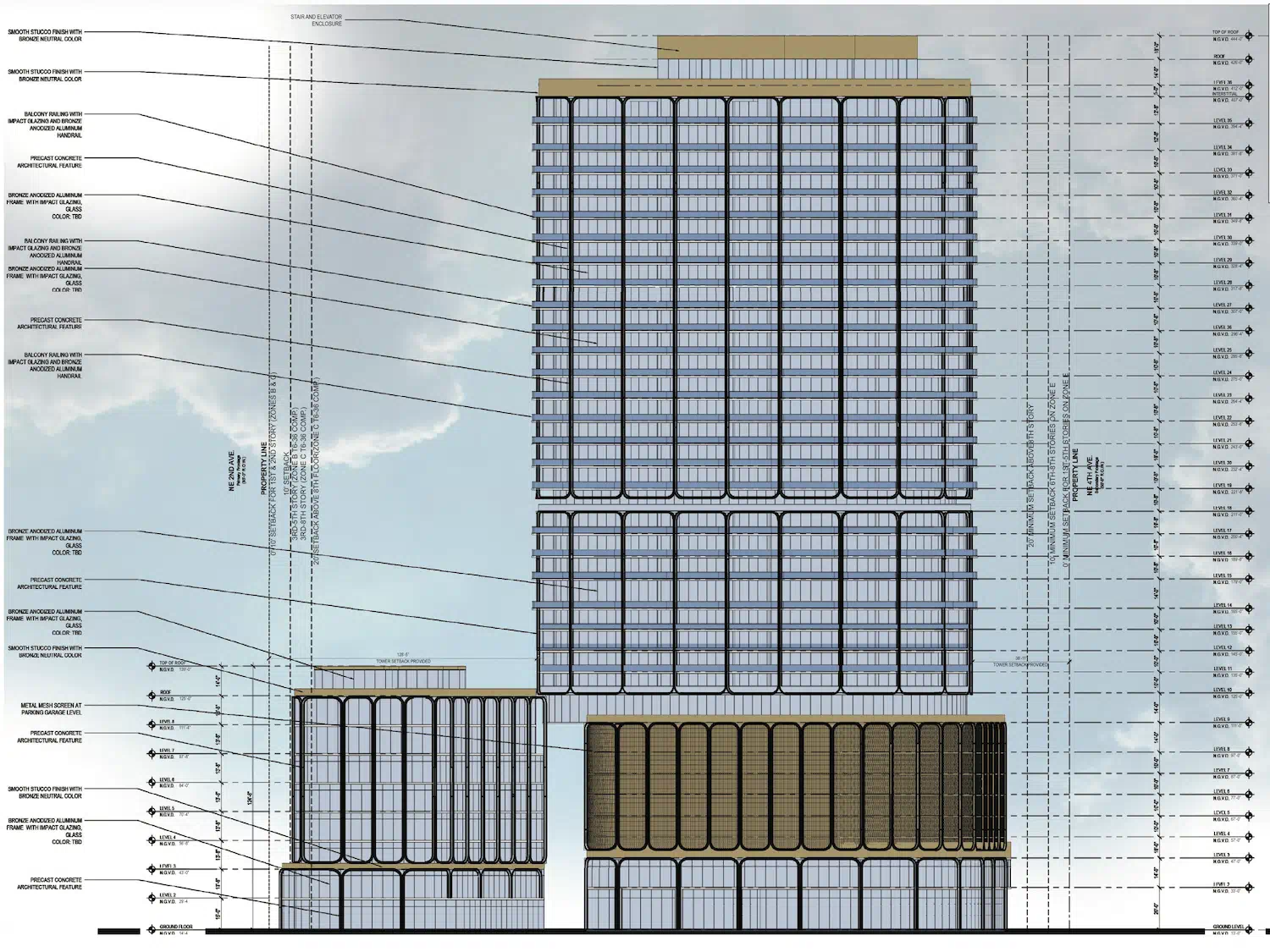
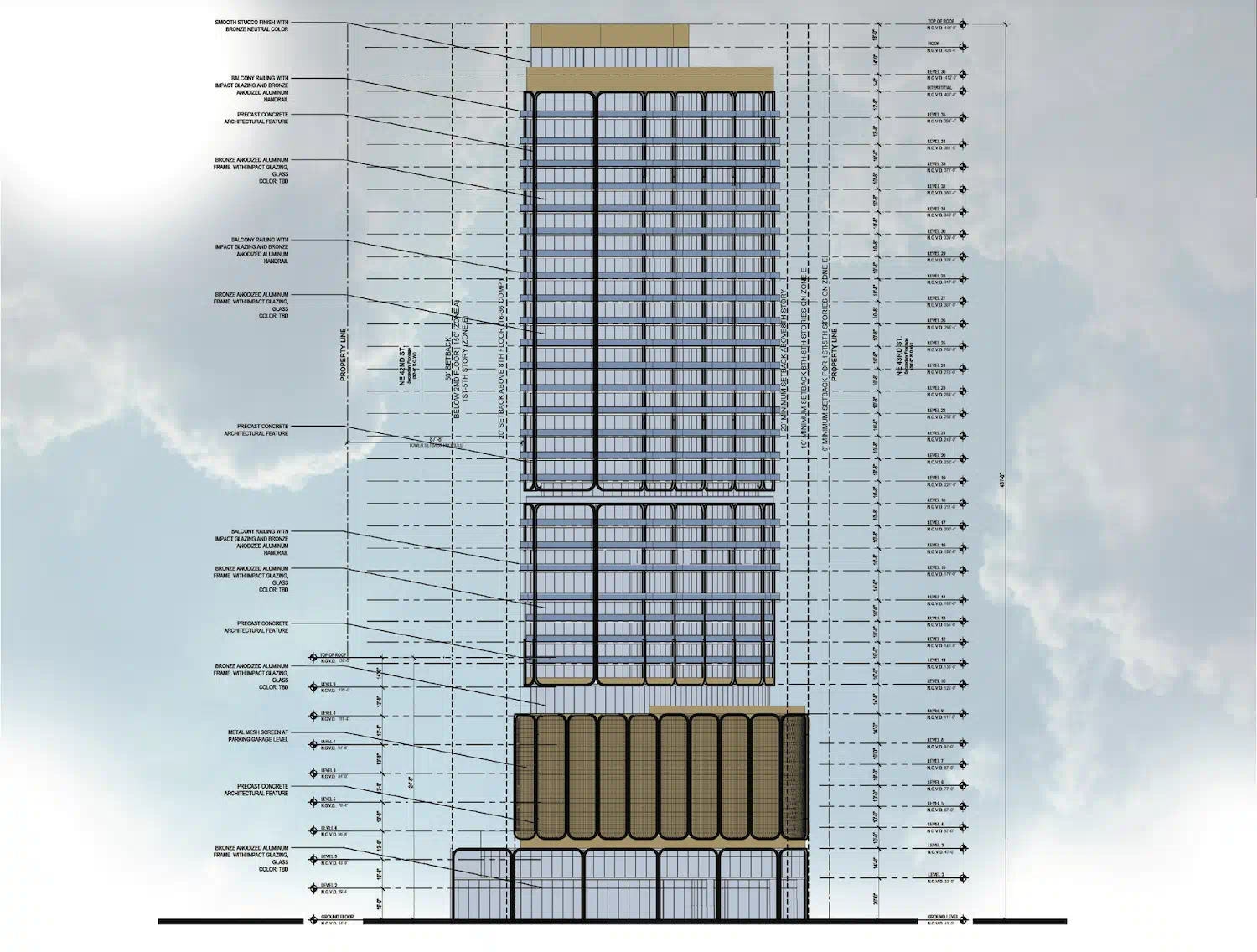
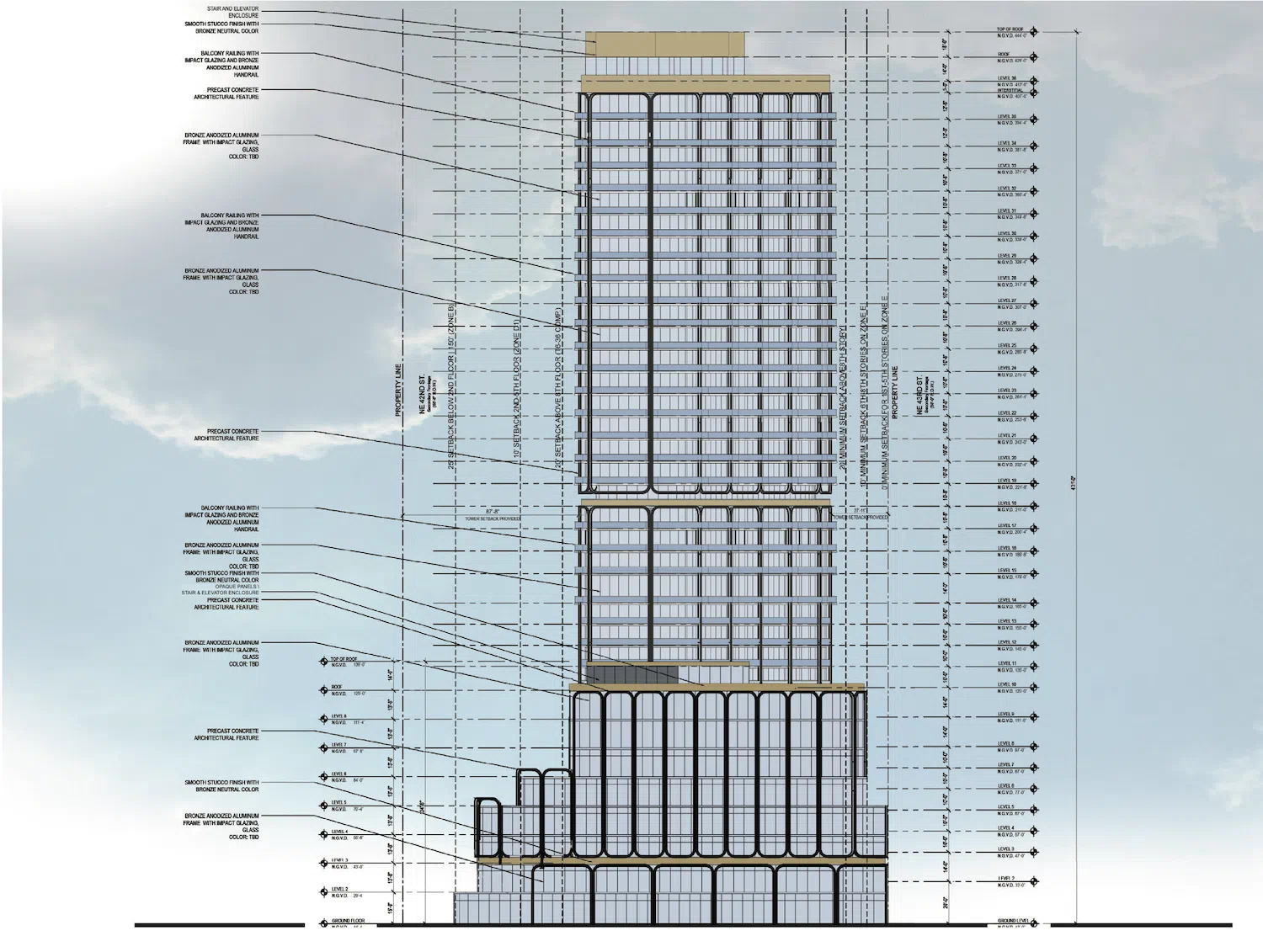
The Helm Design District is a project that makes sense to consider as “urban” real estate in Miami, with a strong location and a clear investment rationale: residential, office, and street retail in one of the city’s most prestigious and in-demand areas—the Miami Design District.
The project is located at 220 NE 43rd Street, Miami, on a 1.89-acre site (80,980 sq ft) within the Miami Design District Retail Street Special Area Plan (SAP), Block 5 East.
Key Facts (facts and figures)
• Address: 220 NE 43rd Street, Miami
• Format: mixed-use, 2 buildings
• East building: 36 floors (residential tower)
• West building: 8 floors (office + retail/commercial)
• Total area: approximately 971,760 gross sq ft
• Residential program: 278 units, including 162 for-sale condos and 116 affordable rental units
• Offices: 101,433 sq ft
• Commercial/retail: 56,409 sq ft
• Parking: up to 613 spaces, including an underground level; entry/exit — NE 4th Avenue
• Public spaces: Open Space 6,235 sq ft and Civic Space 13,687 sq ft
• Team: architecture by CUBE3, landscape by Savino Miller, engineering/traffic by Kimley-Horn, land use counsel by SMGQ Law
• Live Local Act: the city confirms compliance (zoning verification letter dated December 20, 2023)
• Live Local condition (as described in the project): at least 40% of units at up to 120% AMI for 30 years
Miami Design District is an area where real estate value is supported not only by “square footage” but also by the quality of the urban environment: culture, designer retail, walkable daily life, a steady flow of visitors, and proximity to the city’s central districts.
For that reason, projects here are more often perceived as assets with a location premium—especially when a development has a strong ground floor and a properly built connection to the street.
This matters for the buyer: liquidity in such locations is more often sustained because the area is appealing not seasonally, but consistently — both for living and for long-term ownership.
The project is presented as a two-part composition: a 36-story eastern tower for residential use and an 8-story western building for offices and commercial uses. The materials emphasize an approach to building massing through setbacks and terraces: create a more “human” street-level scale first, then rise vertically.
A separate emphasis is placed on the ground level: it is intended to be active, transparent, and oriented toward the street (storefront character, floor-to-ceiling glazing, softened corner forms), which is especially important for the Design District, where architecture “lives” at a pedestrian scale.
One of Helm’s strengths is its mixed-use model.
Within a single address, it combines:
• residential residences (278 units),
• an office component (101,433 sq ft),
• and commercial/street retail (56,409 sq ft).
This increases the project’s resilience as an urban destination: activity is generated not only by residents, but also by office traffic and retail visitors. For a buyer of an apartment in Miami, this often means a more “alive,” convenient environment and the potential for more устойчивый demand for the location.
Live Local Act: why the project can be larger in scale
Helm is presented as a Live Local Act project, and the materials state that the city confirmed compliance via a zoning verification letter dated December 20, 2023. The project description also states the key condition: at least 40% of units must meet income restrictions (up to 120% of AMI) for 30 years.
The practical meaning for the market: if these conditions are met, the project can use enhanced parameters, potentially enabling stronger overall scale in one of the city’s most highly valued urban zones.
Public spaces: an important factor in “long-term value.”
The documents state:
• Open Space — 6,235 sq ft,
• Civic Space — 13,687 sq ft.
For the Design District, this is not an “add-on,” but part of the underlying logic: high-quality public spaces strengthen pedestrian scenarios, increase the attractiveness of the ground level, and ultimately support how the project is perceived and how well it “ages” over time — which is directly connected to liquidity.
Helm Design District may be of interest to those who view real estate in Miami as:
In this sense, Helm is a new development in Miami for those who want a strong location at an early stage and who rely on the district's logic, not just the characteristics of a specific building.
How Bogatov Realty helps buyers and investors
Bogatov Realty supports transactions in Miami’s premium segment, from project and location analysis to negotiations and a secure closing.
We help clients to:
• verify facts through public documents (program, height, parking, open/civic space, Live Local conditions),
• compare Helm with alternatives in the Design District / Edgewater / Midtown in terms of liquidity and stage-related risks,
• build a clear purchase strategy: live, rent, or invest for resale,
• structure the transaction so that key terms and timelines are fixed and transparent for the buyer.
If you are considering Helm Design District as a place to live or as an investment, Bogatov Realty will help you navigate the entire process — from analysis and comparison to negotiations and a secure closing — relying on facts and strategy, not just renderings.