
“A coffee roaster once worked this corner. Now Wynwood Norte weaves through it.”
Walk north on NW 5th Avenue past the mural-covered warehouses and the street goes quiet — the last of the Fashion District’s wholesale storefronts, a middle school, the low white bulk of the Bakehouse Art Complex. On the corner of 32nd Street, where a coffee roasting company once ran its machines, MVRDV has drawn a building that looks like a bolt of fabric unrolled and folded six times.
WOMA joins the short list of pre-construction condos for sale in Wynwood Norte, built around an idea most towers ignore: the street outside is part of the home.
WOMA Wynwood by MVRDV
A Quito Developer’s First American Building
WOMA is the U.S. debut of Uribe Schwarzkopf, the Ecuadorian developer that spent five decades turning Quito into an unlikely stop on the global architecture circuit. By its own count, the firm has completed more than 140 projects and over 2.5 million square meters of construction, commissioning buildings from Bjarke Ingels Group (IQON, Quito’s tallest tower), Safdie Architects, Kengo Kuma & Associates, Ateliers Jean Nouvel, MAD Architects and Arquitectonica.
Projects such as EPIQ and Qapital in Quito, The Hills in Guayaquil and La Maison in Cuenca show a consistent habit: hire the architect most developers would consider too opinionated, and let them be opinionated.
The Miami entity, WOMA Wynwood LLC, assembled a 1.1-acre site at NW 5th Avenue and NW 32nd Street for a reported $25 million earlier in 2026. Sales launched in September 2026 with Berkshire Hathaway HomeServices EWM Realty leading marketing.
Buyers should register one fact clearly: this is the firm’s first project under Florida law, Florida contractors, and Florida inspectors. Its Ecuadorian record is substantial, but it is not a Miami delivery record — and that distinction belongs in any honest due-diligence conversation.
“Cities are not made of concrete and glass,” says CEO Joseph Schwarzkopf. “They are made of relationships.” In Wynwood, where a decade of rising rents pushed out many of the makers who built the district’s reputation, that sentence carries more weight than it would on Brickell Avenue.
The Building: MVRDV’s Woven Façade
MVRDV, the Rotterdam practice founded in 1993 by Winy Maas, Jacob van Rijs and Nathalie de Vries, is known for Valley in Amsterdam’s Zuidas and the mirrored Depot Boijmans Van Beuningen in Rotterdam — buildings that treat a façade as an argument rather than a skin.
At WOMA, founding partner Jacob van Rijs leads the design, with Kobi Karp Architecture & Interior Design as co-architect and architect of record, Kimley-Horn on landscape, YHCE Engineering on structure, and JALRW on MEP.
The building reads as a stack of smaller blocks rather than a single slab. Each volume carries its own textile-derived pattern — varied mullion widths, shifting spandrel grids, scalloped metallic mesh — in blue, green, orange, red and silver.
The palette is not decoration for its own sake: Wynwood was Miami’s Fashion District long before it was an Instagram backdrop, and the façade borrows the visual language of the garment trade that still operates a few blocks south. Setbacks and cantilevers break the massing down to a scale closer to the surrounding warehouses, and the residential floors sit beneath a planted roof rather than a mechanical penthouse.
At the corner of NW 5th Avenue and NW 32nd Street, Bolivian-born fashion designer Rosita Hurtado will place her studio and headquarters behind a façade of golden, scale-like panels — the one place where the building drops its weave and switches to sequins.
The center of the project is a raised public plaza at mezzanine level, reached by broad staircases that pass between the volumes. According to designboom’s coverage, the stairs are finished in Bisazza glass mosaics carrying Fornasetti’s recurring hand motif.
Shops and offices frame the plaza; MVRDV programs it for exhibitions, fashion shows and fundraisers. It is a genuine public room — which also means residents share their front steps with the neighborhood, by design.
Residences, Floor Plans & Pricing
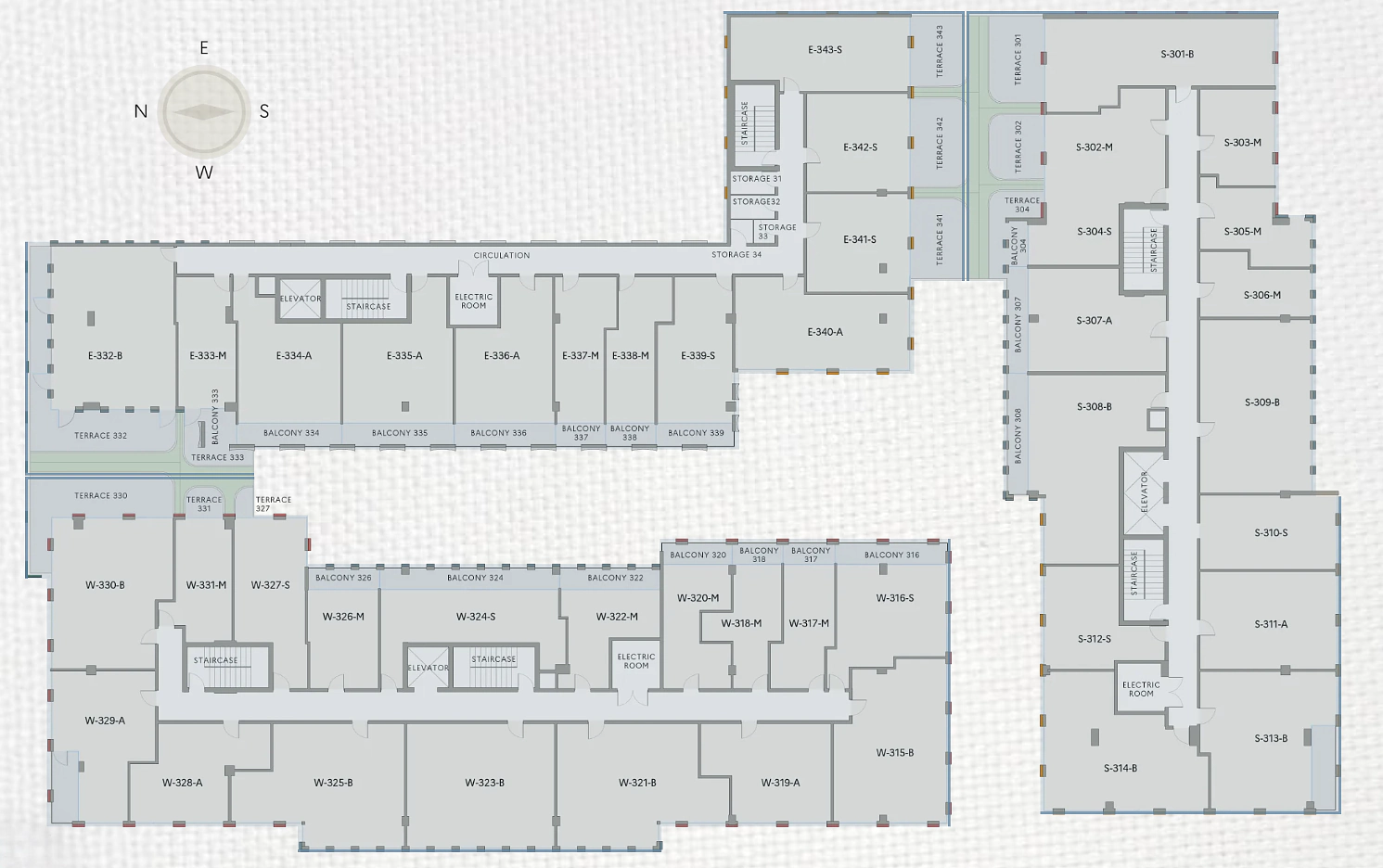
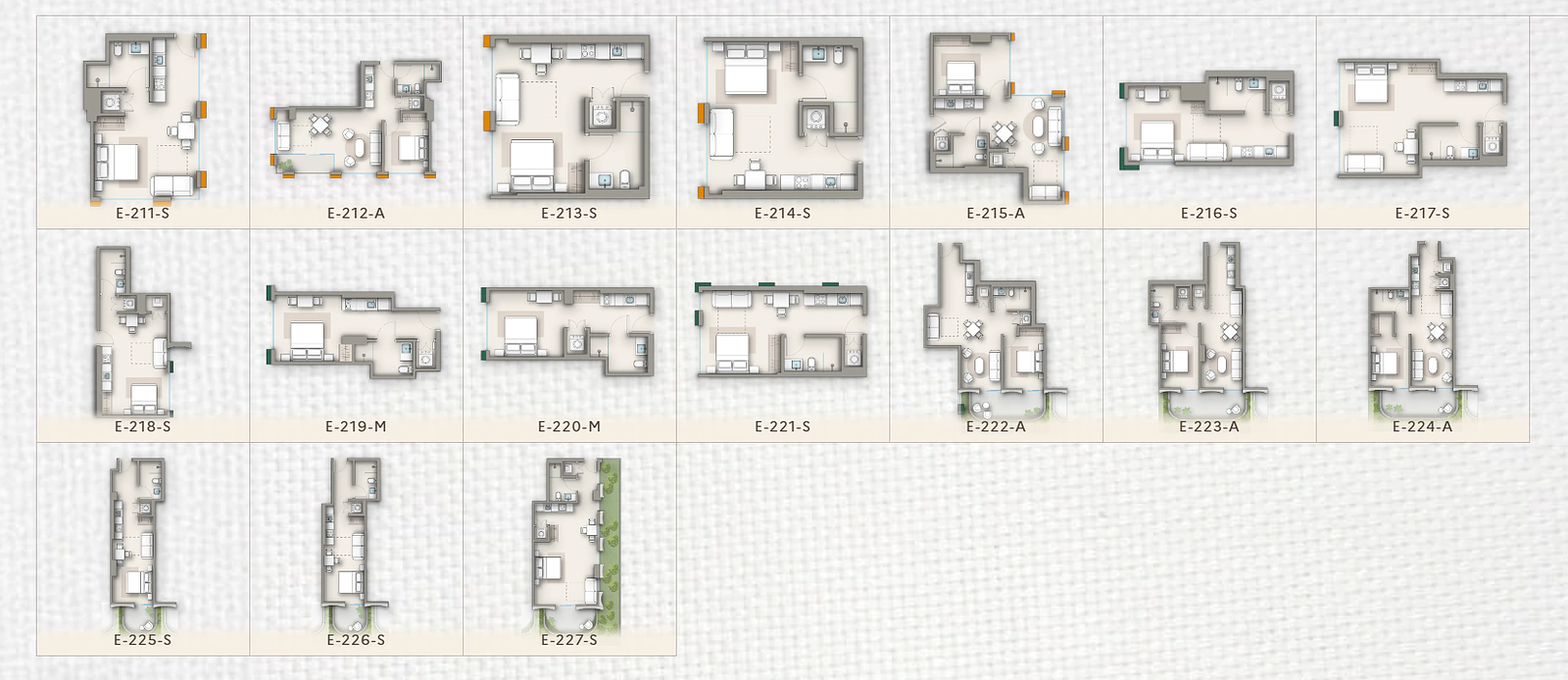
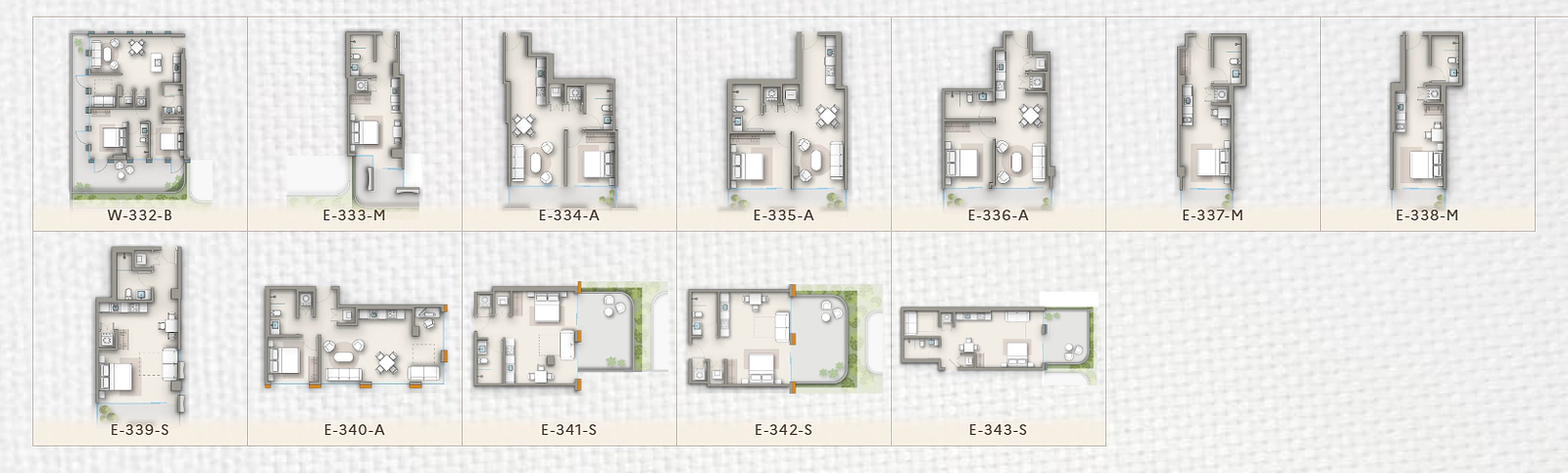
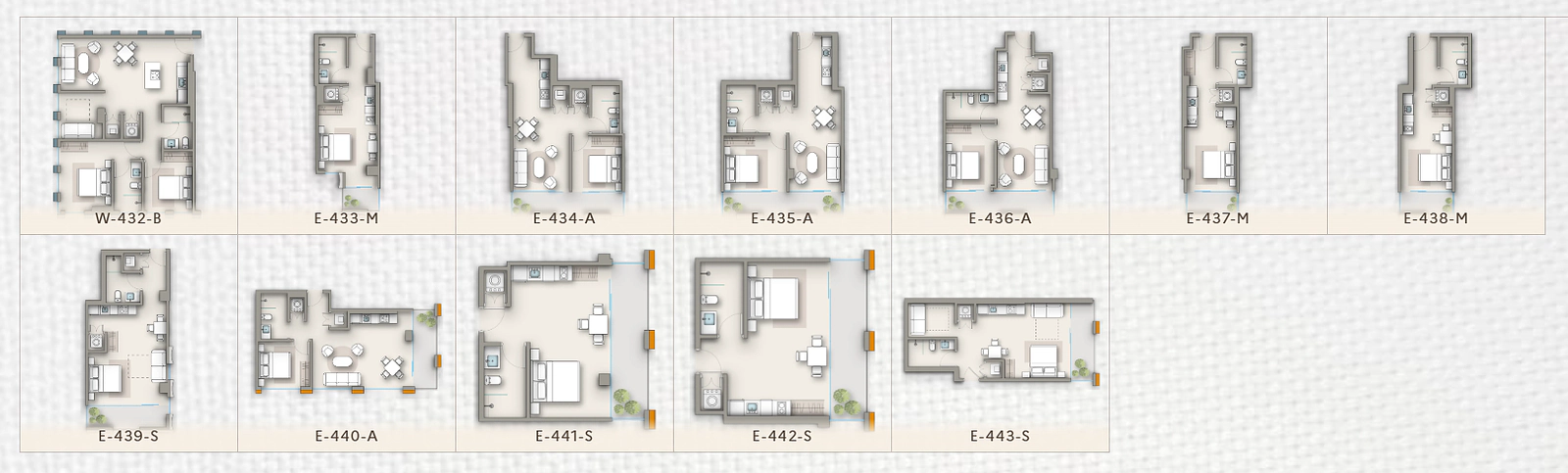
WOMA comprises 163 residences, ranging from micro-studios capped at roughly 320 sq. ft. to three-bedroom homes, plus 1- and 2-bedroom layouts with dens, a limited collection of duplex ateliers, one penthouse with a private terrace, 16 micro-offices and 13 retail spaces.
All residences come with complete kitchens, bathrooms, and appliances; the developer has not yet published finish or appliance brands. Storage units are offered through usage rights rather than deeded ownership.
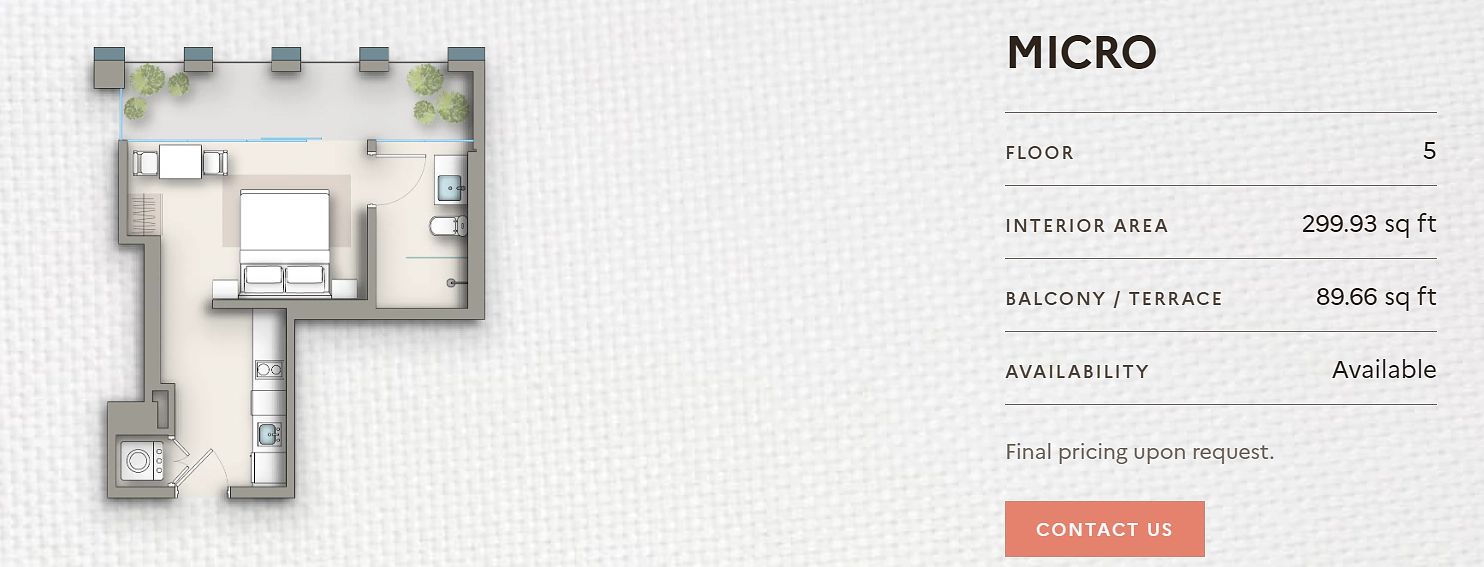
For buyers looking to buy a condo in Wynwood below the price of a typical Midtown one-bedroom, the micro-units are the most interesting product here. The plan types are honest about their size: a 299.93 sq. ft. micro with an 89.66 sq. ft. terrace is laid out as one long room with a sleeping zone, galley kitchen, and a full bath, with the terrace doing the work a second room would do elsewhere.
| Type | Interior sq. ft. (sample plan) | Terrace/balcony sq. ft. | Price from |
|---|---|---|---|
| Micro studio | 295–320 | up to 89.66 | $416,200 |
| Studio | 449 | varies by plan | $608,500 (listed) |
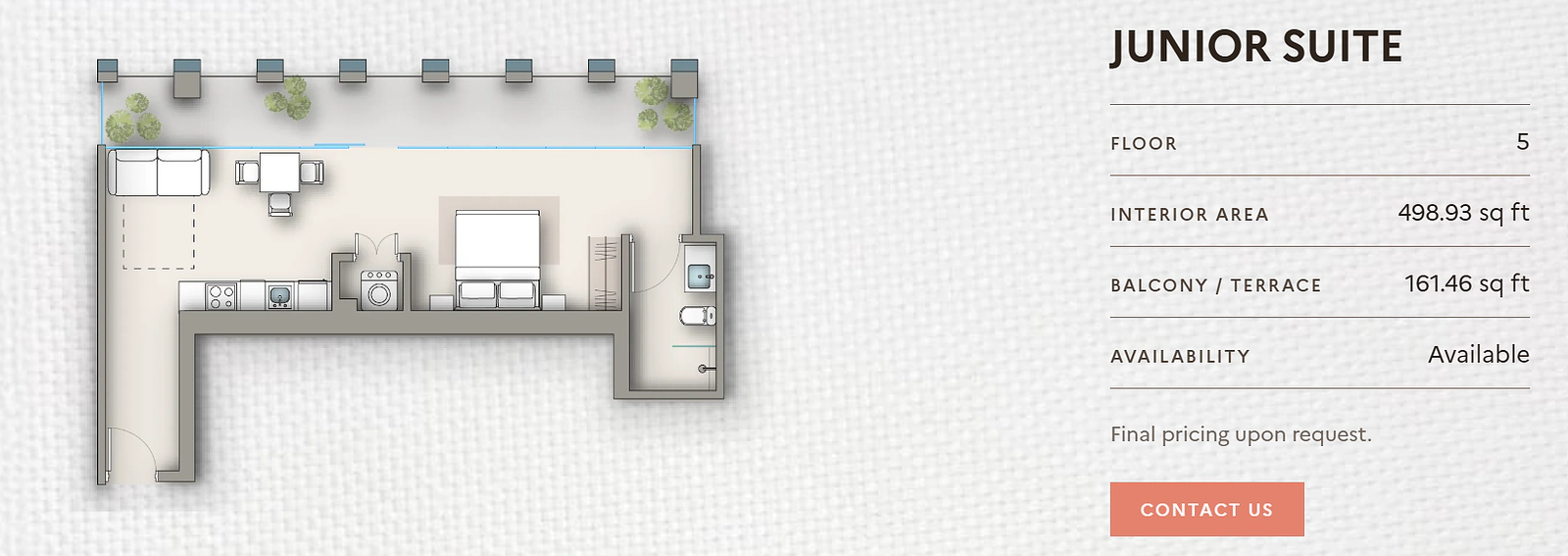
| Junior suite | 498.93 | 161.46 | Upon request |
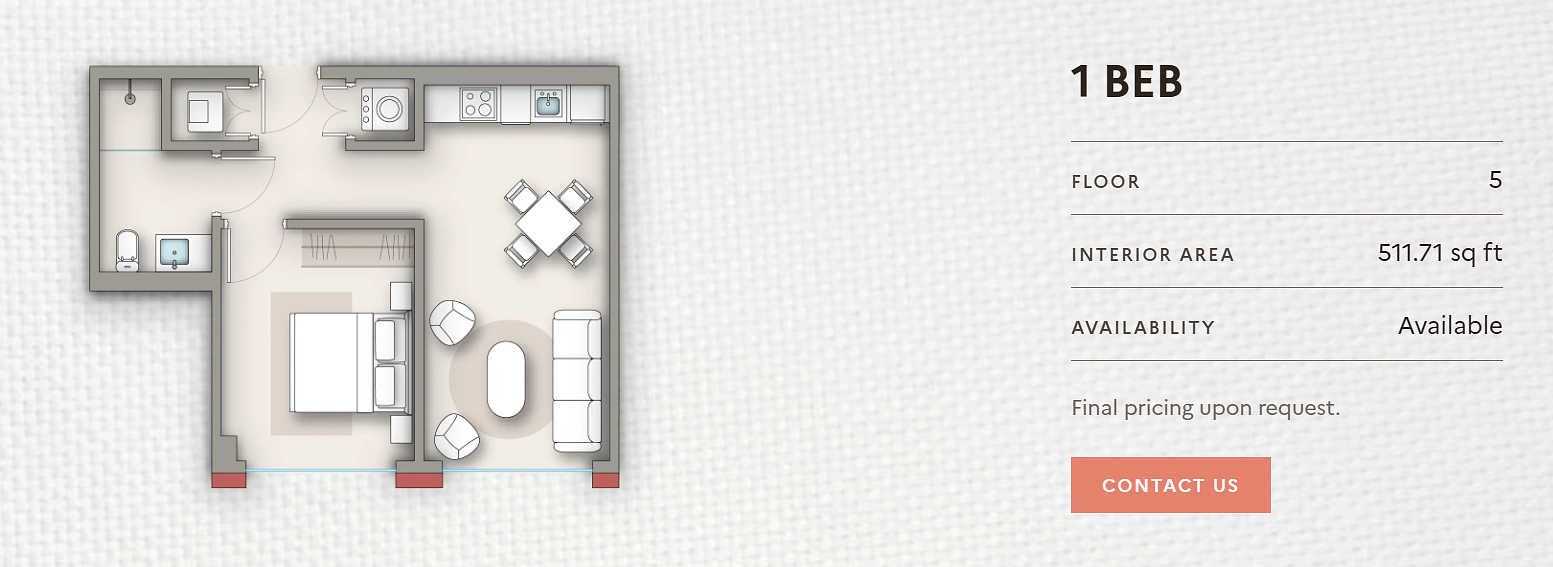
| One-bedroom | 511.71 | — | Upon request |
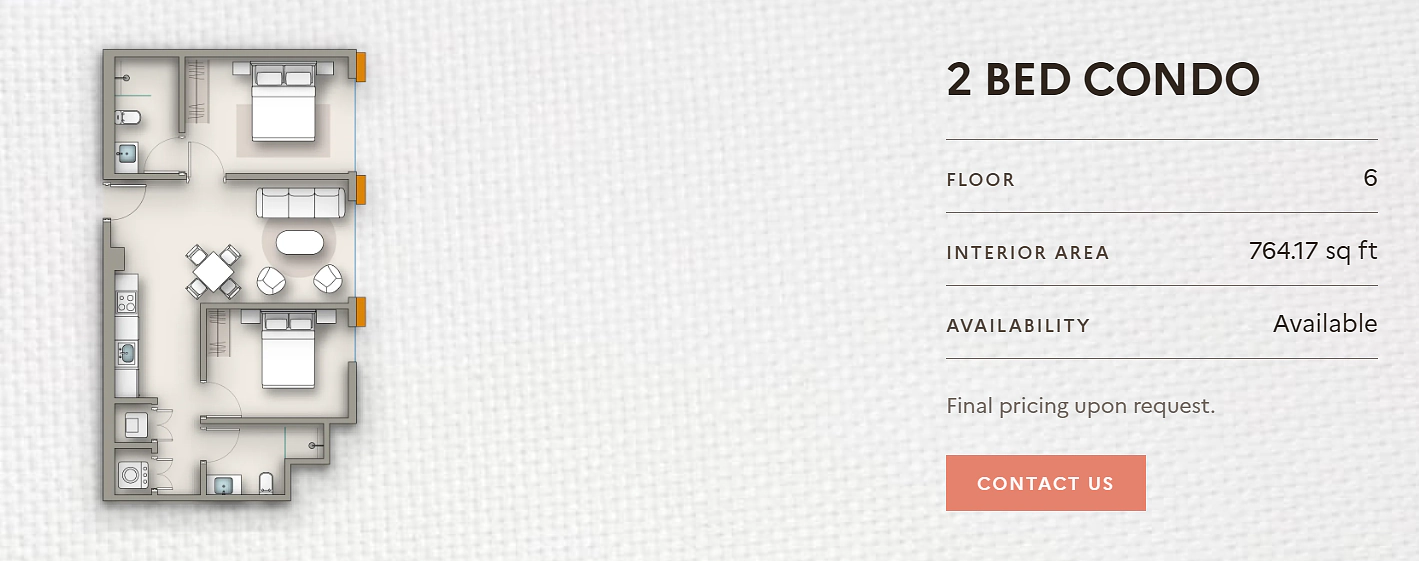
| Two-bedroom | 764.17 | — | Upon request |
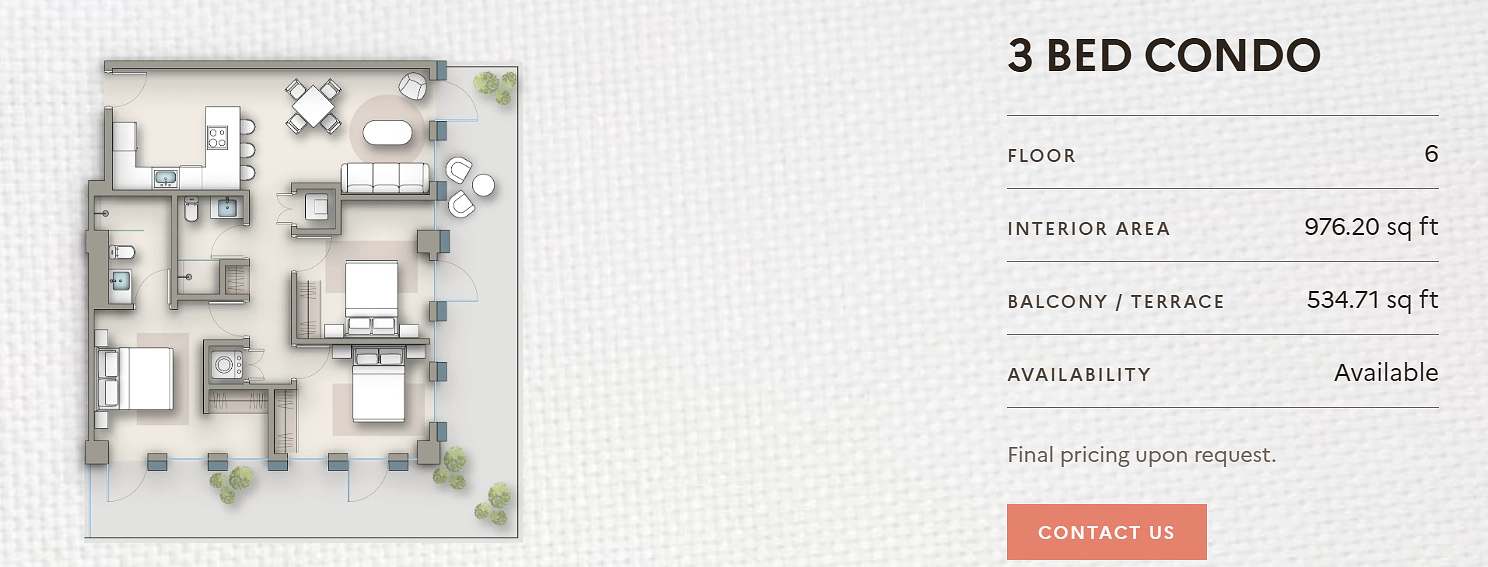
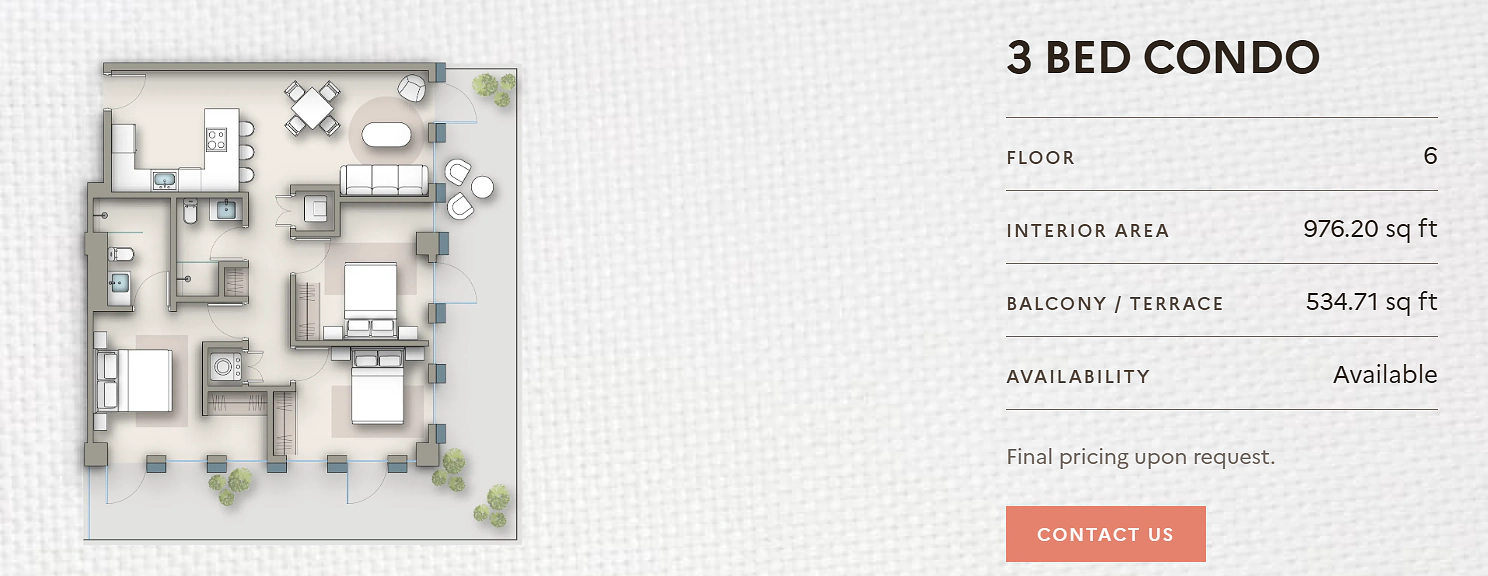
| Three-bedroom | 976.20 | 534.71 | Upon request (range tops at $1,665,000) |
| Duplex atelier | approx. 700 | plaza frontage | Upon request |
Prices reflect active MLS listings as of October 2026; launch coverage in September 2026 quoted entry pricing from $380,000. The developer sets final pricing and availability.
On the two listings currently public, pricing works out to roughly $1,350–$1,410 per interior square foot — before terrace area is counted. That is a premium to Wynwood resale stock, and it reflects both the design pedigree and the small-unit format, where fixed costs (a full kitchen, a full bath) are spread over fewer feet.
The plan with the strongest argument is the sixth-floor three-bedroom: 976.20 sq. ft. inside and a 534.71 sq. ft. L-shaped terrace — more than half of the interior space. The four duplex ateliers face the mezzanine plaza through double-height windows and combine living space with studio and exhibition area; they are designed to work as a studio and a storefront gallery at the same time.
Amenities
Rooftop. A communal terrace with a semi-Olympic pool, landscaped garden lounges and panoramic views across Wynwood. A terrace pet park sits on the same level — unusual in a building of this size, and a quiet admission that a large share of Wynwood’s residents have dogs.
Wellness terrace. Fitness studio, sauna, steam room and an outdoor pickleball court, set on planted terraces created by the building’s setbacks — the kind of wellness floor that usually requires a 40-story tower to justify.
Work and social. A business center with meeting rooms for residents who work from home, a cinema, a game room and a kids’ room.
Public realm. The mezzanine plaza and street-level retail along NW 32nd Street, NW 5th Avenue, and NW 33rd Street — three active frontages — mean the ground floor of WOMA will be busy whether or not residents are home.
Neighborhood Deep-Dive: Wynwood Norte
Wynwood Norte is the roughly 140-acre district north of NW 29th Street that the City of Miami upzoned in 2021, allowing up to 150 units per acre in exchange for affordable-housing contributions. In practice, it is where Wynwood’s graffiti blocks give way to a residential grid of bungalows, small apartment buildings and light-industrial warehouses — the part of the neighborhood that still looks like a neighborhood.
- The Bakehouse Art Complex, a short walk west on NW 32nd Street, has operated since 1987 in a former industrial bakery and houses 65 subsidized artist studios with ceramics, printmaking and wood shops.
- José de Diego Middle School sits directly across NW 32nd Street at 3100 NW 5th Avenue, and Roberto Clemente Park on NW 34th Street is about a quarter-mile north.
- The Wynwood Walls on NW 2nd Avenue are roughly 0.8 miles away — a 15-minute walk — and Midtown Miami’s retail is about a mile east.
- The Miami Design District is approximately 1.5 miles northeast; the Rubell Museum and Superblue in Allapattah are about a mile southwest.
- By car, Miami International Airport is about 6 miles west: roughly 15 minutes outside rush hour and 30–40 minutes on a weekday evening.
- Brickell is about 4 miles south (12–15 minutes off-peak, often 30 at 5 p.m.), and Lincoln Road in Miami Beach is about 6 miles east via the Julia Tuttle Causeway. Interstate 195 is a few blocks north.
What the neighborhood does not offer: walkable rail transit. The nearest Metrorail stations are well over a mile west, and the commuter-rail stop referenced in the developer’s materials — a long-discussed Northeast Corridor station near NE 27th Street — has no confirmed opening date.
Most residents will drive or ride-share. There is no water access; the nearest beach is across the bay. NW 5th Avenue itself is still a transitional street, with uneven sidewalks, vacant lots, and school-drop-off congestion on weekday mornings.
A Saturday in Wynwood Norte
Wynwood Norte doesn’t wake up early on a Saturday, and the part of Wynwood south of 29th Street wakes up even later.
- At eight, the only real movement on NW 5th Avenue is a few parents walking dogs toward Roberto Clemente Park and a delivery truck backing into a warehouse bay, beeping for longer than seems necessary.
- By nine-thirty the line at Zak the Baker on NW 26th Street is already out the door — it is the sourdough that people come for, and the regulars know to order the loaf first and decide on the pastry while they wait.
Coffee is a short walk away at Panther Coffee on NW 2nd Avenue, where the original Wynwood café reportedly still smells faintly of roasting on busy mornings. There is a small irony in carrying that cup back to a building that stands on the site of a former roaster.
Afternoons in summer belong to the weather. Around three, the sky over Allapattah turns slate gray, the rain arrives in one sheet, and twenty minutes later the asphalt is steaming, and the tour groups on NW 2nd Avenue reappear with ponchos and phones held over their heads. Residents learn to schedule errands around it; visitors never quite do.
On open-studio days, the Bakehouse Art Complex unlocks its studios to the public, and the corridor on NW 32nd Street fills with collectors, students and artists’ families drifting between ceramics kilns and printmaking presses. It is the closest thing the neighborhood has to a town meeting.
Dinner is a decision about volume. The louder choice is a ten-minute drive to Mandolin Aegean Bistro in the Design District, where the garden tables under the trees fill by eight, and nobody seems in a hurry to give them up.
The quieter one is to stay home, take the elevator to the roof, and watch the downtown towers light up from the pool deck while the bass from NW 2nd Avenue reaches you only as a rumor.
The Investment Case
The comparison that matters is with Wynwood’s other new residential buildings — and WOMA has made the opposite bet from most of them. NoMad Residences Wynwood at 2700 NW 2nd Avenue, a 329-residence building, is marketed with no rental restrictions and an in-house short-term rental management team, with current listings from about $725,000.
Casa Wyn, a 24-residence boutique by ABH Development Group with Modis Architects at 355 NW 31st Street — two blocks from WOMA — is also marketed with no rental restrictions. WOMA, by contrast, will not permit short-term rentals, according to the developer’s statements at launch.
That makes WOMA a weaker product for Airbnb operators and a stronger one for nearly everyone else. A building without nightly turnover tends to hold its owner-occupant base, keep amenity wear and insurance exposure lower, and feel like a residence rather than a hotel corridor.
For investors, the case rests on long-term leasing to the people the district actually attracts: designers, gallery staff, hospitality professionals and remote workers who want a Wynwood address at a micro-unit price. Neither NoMad nor Casa Wyn offers an MVRDV-designed building, a public plaza, or plaza-level ateliers.
The context supports the thesis without guaranteeing it. The 2021 rezoning signals that the City of Miami intends Wynwood Norte to densify, and new construction delivered under Florida’s post-Surfside condominium-safety laws (SB 4-D in 2022 and SB 154 in 2023) must fund structural reserves from day one rather than inheriting a deferred-maintenance bill.
Monthly association dues on current MLS listings range from about $644 to $1,208 depending on unit size; the final budget will be set in the condominium documents. Rental policy beyond the short-term ban, including minimum lease terms, remains subject to HOA finalization.
A Building That Could Only Exist on This Block
Most new Miami condominiums could be moved ten blocks in any direction without anyone noticing. WOMA could not. Its colors come from the garment trade, its plaza from the Bakehouse’s open-studio days, its ateliers from the artists who made the district worth moving to and then were priced out of it.
Whether the neighborhood around it keeps that character is not something any developer controls. But for buyers weighing pre-construction condos for sale in Wynwood Norte, it is rare to find one that is so clearly built to be part of the street rather than above it.
Frequently Asked Questions
When will WOMA Wynwood be completed?
The developer’s news page marked a groundbreaking in August 2026, while launch coverage the following month placed the start of full construction in spring 2027. Delivery is targeted for the final months of 2029. As with any pre-construction purchase, the condominium documents — not marketing materials — govern the timeline.
Can I rent out my residence at WOMA?
Not on a nightly or short-stay basis: the developer has stated that short-term rentals will not be allowed. Long-term leasing is permitted per the project website, but minimum lease terms and leasing procedures will be defined in the HOA rules, which are not yet final.
What is the difference between the micro-units, studios and ateliers?
Micro-units are compact single-room homes with a full kitchen and bath, often with a terrace that functions as a second room. Studios and junior suites add width and a defined sleeping zone. The duplex ateliers are two-level live-work homes facing the mezzanine plaza, designed for artists and makers who want to work, exhibit and live at the same address.
Who is designing the interiors?
MVRDV’s project credits list Uribe Schwarzkopf as interior architect, with Kobi Karp Architecture & Interior Design as the local architect of record. Specific finish, cabinetry, and appliance brands have not been published yet, so ask a Bogatov Realty advisor for the latest specification sheet before signing.
Is WOMA a good investment?
It depends on the strategy. For an Airbnb-driven plan, other Wynwood buildings are a better fit; for long-term leasing or a pied-à-terre, the no-short-term-rental rule, small-unit entry price, and design-led profile work in the buyer’s favor. Watch the construction schedule and the final association budget, both of which a Bogatov Realty advisor can track for you through closing.
Can I buy a micro-office or storage unit?
Yes. WOMA offers a limited collection of micro-offices, reached by elevator or stairs from the plaza, and storage units sold through usage rights. Both can be purchased alongside a residence, subject to availability.
How does WOMA compare with NoMad Residences or Casa Wyn?
Both competitors allow short-term rentals; WOMA does not, and it offers a public plaza and an architect-led design neither of them has. For a side-by-side comparison of current pricing and availability, contact Bogatov Realty.
“The roaster has cooled. The weave is just beginning.”
To explore floor plans at WOMA Wynwood or compare it with other new developments in Wynwood Norte, contact a Bogatov Realty advisor or submit an inquiry on this page. Prices, availability, and timelines are current as of October 2026 and subject to change by the developer. Oral representations cannot be relied upon as correctly stating the representations of the developer; for correct representations, refer to the documents required by Section 718.503, Florida Statutes.